GitSummarize
Turn GitHub repos into AI-powered documentation instantly
What is GitSummarize? Complete Overview
GitSummarize is an innovative AI tool that transforms any GitHub repository into comprehensive, easy-to-understand documentation. Designed for developers, technical writers, and open-source contributors, it solves the pain point of manually creating and maintaining documentation for complex codebases. By simply replacing 'hub' with 'summarize' in a GitHub URL, users can generate structured documentation that explains the repository's purpose, key features, and technical architecture. The tool supports popular repositories across all major programming languages and frameworks, making it invaluable for teams onboarding new members, maintaining legacy code, or preparing projects for public release.
GitSummarize Interface & Screenshots
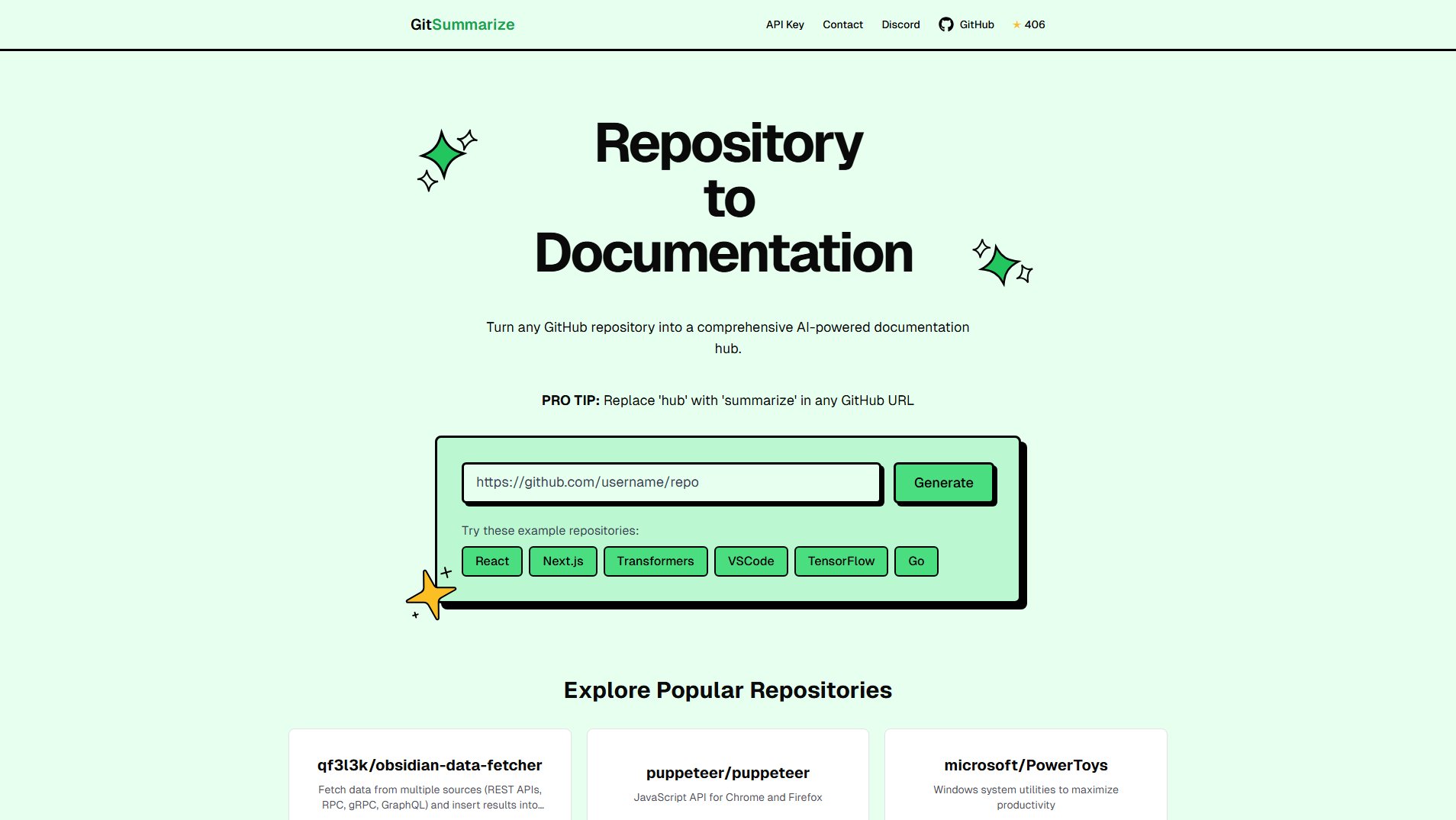
GitSummarize Official screenshot of the tool interface
What Can GitSummarize Do? Key Features
Instant Documentation Generation
With a single URL modification, GitSummarize analyzes the entire repository structure, code files, and commit history to produce coherent documentation in seconds. The AI understands code context, dependencies, and architectural patterns to generate accurate summaries.
Multi-Language Support
The tool works seamlessly across 50+ programming languages including JavaScript, Python, Go, Rust, and Java. It recognizes language-specific patterns and generates appropriate documentation formats (JSDoc for JavaScript, docstrings for Python, etc.).
Repository Context Understanding
GitSummarize's AI examines commit messages, issue history, and pull requests to include project evolution context in documentation. This helps new contributors understand why certain implementation decisions were made.
Interactive Examples
For demonstration repositories, the tool can generate runnable code snippets with explanations. Users can test examples directly from the documentation without cloning the repo.
Customizable Output
Users can specify documentation focus areas (API reference, architecture overview, contributor guidelines) and choose between multiple output formats including Markdown, HTML, and Confluence-compatible formats.
Best GitSummarize Use Cases & Applications
Open Source Maintainers
Project maintainers can automatically generate up-to-date documentation for contributors, reducing onboarding time from days to hours. The tool helps standardize documentation across large OSS organizations.
Technical Due Diligence
VC firms and acquirers use GitSummarize to quickly understand code quality and architecture of potential investments without deep technical reviews, analyzing multiple repos in parallel.
Developer Education
Bootcamps and computer science programs generate annotated versions of popular repositories (like React or TensorFlow) to help students learn from real-world codebases with expert explanations.
How to Use GitSummarize: Step-by-Step Guide
Take any GitHub repository URL (e.g., https://github.com/facebook/react) and replace 'hub' with 'summarize' to get https://gitsummarize.com/facebook/react
The tool will automatically analyze the repository's structure, code files, and commit history. No authentication or API keys required.
View the generated documentation organized by key components. The AI highlights architectural patterns, main functions, and dependencies.
Use the toolbar to export documentation in your preferred format (Markdown, HTML, PDF) or copy specific sections to your clipboard.
For repositories you maintain, click 'Update Docs' to regenerate documentation when new commits are pushed to keep docs synchronized with code changes.
GitSummarize Pros and Cons: Honest Review
Pros
Considerations
Is GitSummarize Worth It? FAQ & Reviews
GitSummarize achieves ~85% accuracy for well-structured repositories. Accuracy improves for projects with consistent naming conventions, comments, and commit messages. The AI flags uncertain interpretations for manual review.
Yes, all output can be edited after generation. For maintained projects, you can set up documentation templates that the AI will follow for consistent styling.
Currently GitHub-only, but GitLab/Bitbucket support is coming in Q3 2024. You can mirror non-GitHub repos to GitHub as a temporary solution.
The tool intelligently samples large repos (100k+ files) focusing on critical paths. Enterprise plans offer full-repo analysis with adjustable depth settings.
Public repo analysis happens on our servers. Enterprise plans offer fully local processing options for sensitive codebases.