Sentient Labs
Open-source AI platform building advanced multi-agent systems
What is Sentient Labs? Complete Overview
Sentient Labs is pioneering open-source artificial intelligence with its GRID products ecosystem. The platform focuses on developing high-performance multi-agent systems through innovative frameworks like ROMA (Recursive Open Meta Agent). Sentient's technology splits complex goals into subtasks and recombines results for sophisticated reasoning, outperforming closed-source alternatives. The company's research spans model security, post-training, agentic safety, reasoning frameworks, and benchmarking. All breakthroughs are released open-source, demonstrating how transparency can surpass proprietary AI development. Key products include Sentient Chat (an open AI platform), Open Deep Search (augmenting LLMs with reasoning agents), Dobby (community-owned AI model), and cryptographic fingerprinting technology. Sentient Labs serves AI researchers, developers, and organizations seeking transparent, community-driven AI solutions.
Sentient Labs Interface & Screenshots
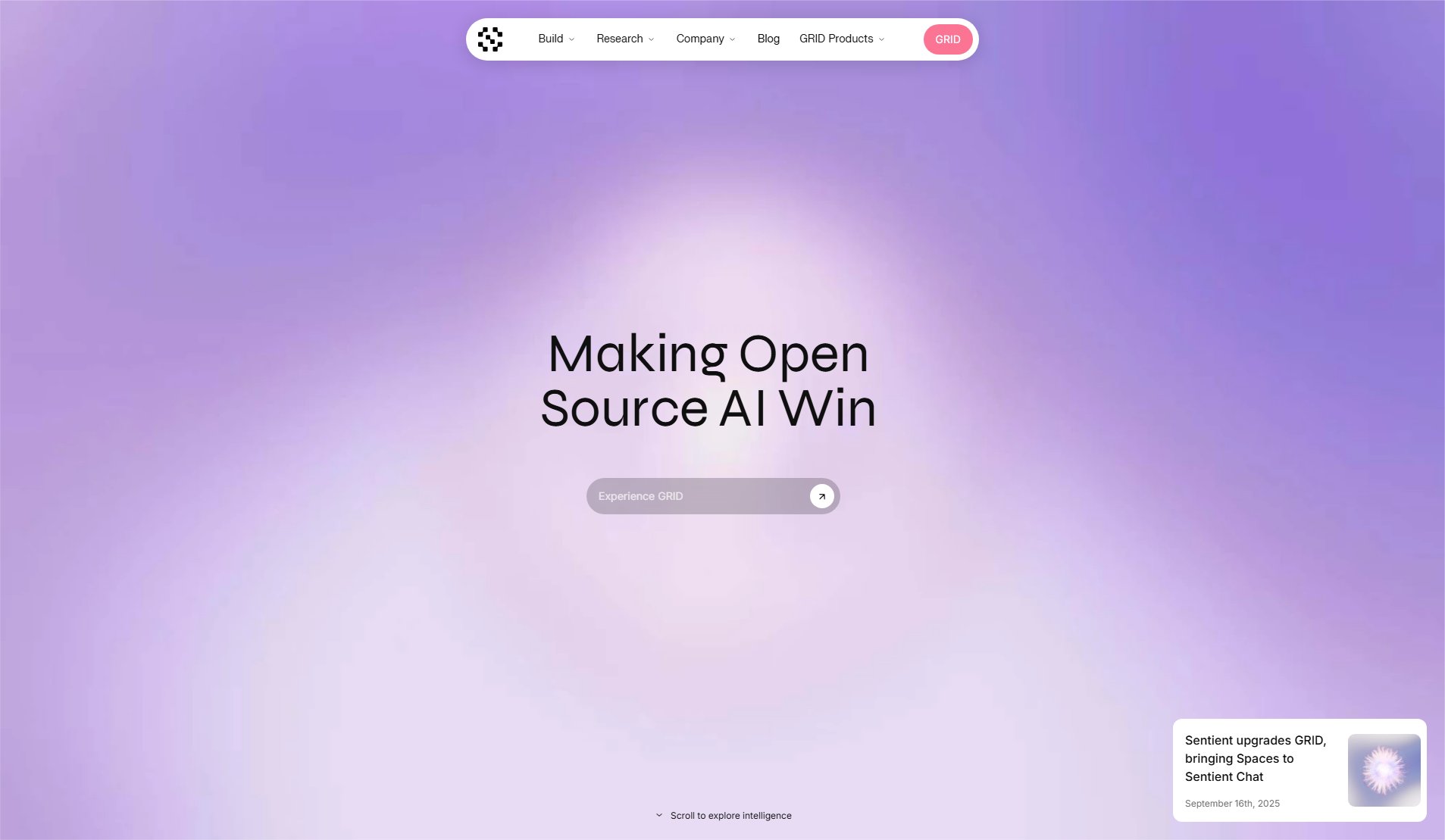
Sentient Labs Official screenshot of the tool interface
What Can Sentient Labs Do? Key Features
ROMA Framework
Recursive Open Meta Agent is Sentient's state-of-the-art open-source framework for building high-performance multi-agent systems. ROMA specializes in splitting large goals into manageable subtasks and intelligently recombining results, enabling sophisticated long-horizon reasoning that competes with closed-source alternatives.
Sentient Chat
The World of Open-Source AI platform allows users to experience GRID artifacts, experiment with open-source repositories, and provide feedback on community AI products. It serves as a gateway to Sentient's ecosystem of AI tools and research outputs.
Open Deep Search
This innovative search tool augments open-source large language models with specialized reasoning agents, achieving state-of-the-art performance that surpasses even GPT-4o Search Preview capabilities.
Dobby Models
The world's first fingerprinted AI model co-owned by over 700,000 community members. These models are explicitly aligned with pro-crypto and pro-freedom values while remaining fully open-source.
Fingerprinting Technology
Sentient's cryptographic library enables embedding undetectable, verifiable signatures into AI models for secure provenance tracking and ownership verification—critical for maintaining trust in open-source AI systems.
Benchmarking Suite
Custom, high-fidelity benchmarks spanning diverse industries including fair coding practices, crypto values, and governance models. These tools help evaluate AI performance across specialized domains.
Agent Security Research
Cutting-edge research identifying security gaps in current open-source agent frameworks and demonstrating how fine-tuned models can strengthen agent capabilities against sophisticated threats.
Best Sentient Labs Use Cases & Applications
Complex Problem Solving
Researchers can use ROMA to tackle intricate scientific problems by breaking them into manageable sub-tasks that AI agents can solve independently before combining results.
Transparent AI Development
Organizations prioritizing AI transparency can build on Sentient's open-source frameworks to create auditable, community-vetted AI systems.
Community-Owned AI
Decentralized communities can adopt and contribute to Dobby models, ensuring AI alignment with their collective values.
Secure Model Provenance
Companies requiring verifiable model origins can implement Sentient's fingerprinting technology to track and authenticate AI assets.
How to Use Sentient Labs: Step-by-Step Guide
Access Sentient Chat through the GRID platform to explore available AI artifacts and open-source repositories.
Experiment with ROMA framework by implementing its recursive task decomposition approach for your specific AI problem.
Integrate Open Deep Search with your preferred LLM to enhance its reasoning and search capabilities.
Utilize Dobby models for applications requiring crypto-aligned or freedom-oriented AI outputs.
Apply fingerprinting technology to your AI models for verifiable provenance and ownership tracking.
Sentient Labs Pros and Cons: Honest Review
Pros
Considerations
Is Sentient Labs Worth It? FAQ & Reviews
Yes, all core technologies including ROMA, Dobby models, and fingerprinting libraries are released as open-source.
ROMA's recursive task decomposition and recombination approach enables it to compete with or surpass closed-source alternatives in complex reasoning tasks.
Yes, Dobby is community-owned with over 700,000 co-owners contributing to its development and alignment.
It combines reasoning agents with novel search techniques to outperform even advanced proprietary search solutions.
Sentient Labs offers various levels of support through its Builder Program and Builder Suite for organizations.