MemU
AI memory layer for LLM apps: organized, linked, evolved
What is MemU? Complete Overview
MemU is an agentic memory layer specifically designed for LLM (Large Language Model) applications, providing higher accuracy, faster retrieval, and lower cost memory management. It transforms memory into an intelligent file system that automatically organizes, connects, and evolves with your AI's knowledge. The platform is particularly valuable for developers building AI applications that require persistent, contextual memory. MemU offers enterprise-grade solutions with commercial licensing options, custom development capabilities, and premium support services. It integrates with popular AI platforms like OpenAI, Anthropic, Gemini, and LangGraph, and supports both Python and JavaScript through its SDK and REST API.
MemU Interface & Screenshots
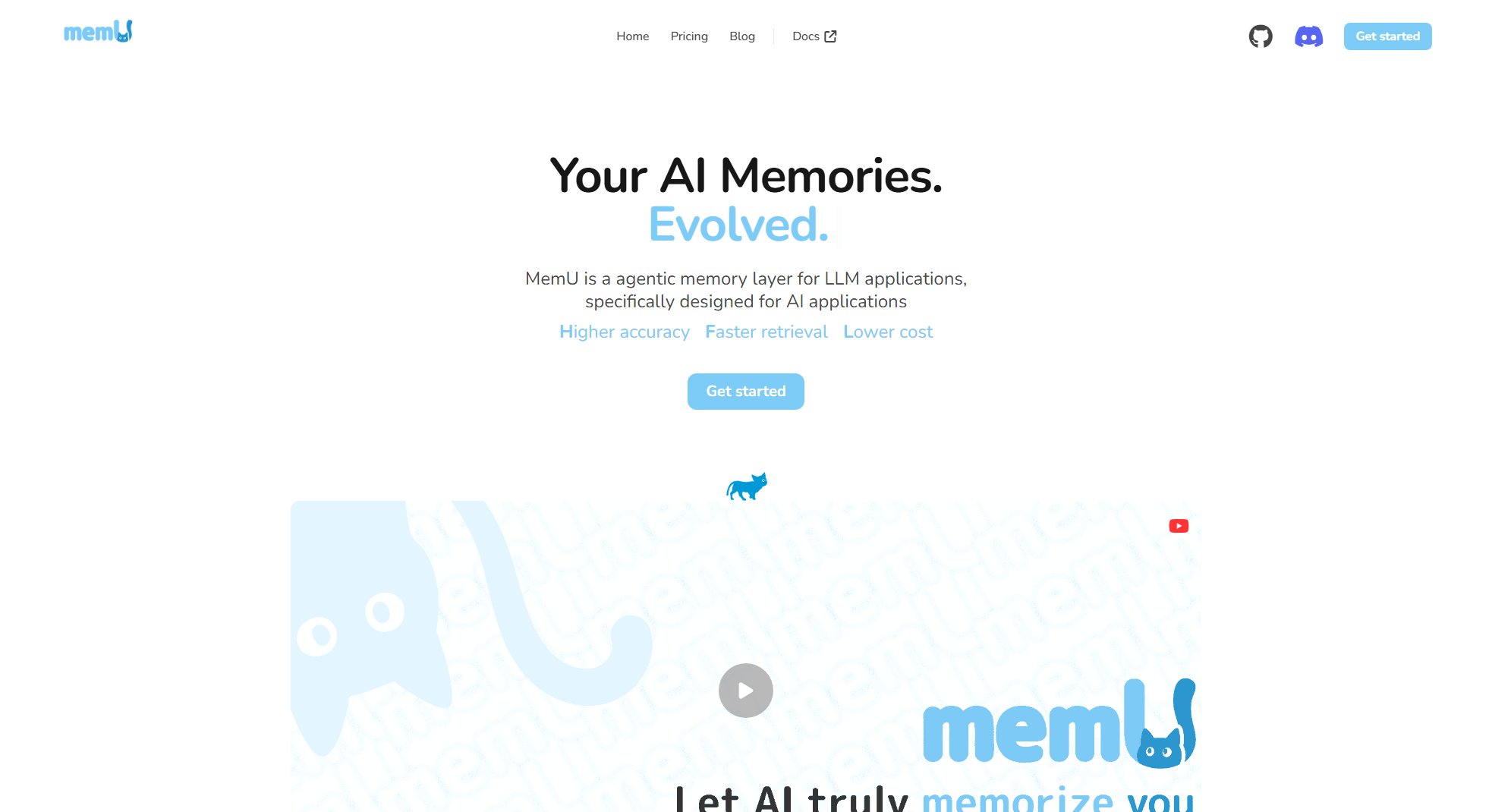
MemU Official screenshot of the tool interface
What Can MemU Do? Key Features
Autonomous Memory Management
MemU automatically organizes memories into a structured system without manual intervention. It intelligently categorizes and stores information from conversations, user preferences, and contextual data, significantly reducing the cognitive load on developers implementing memory solutions.
Interconnected Knowledge Graph
The platform creates dynamic connections between stored memories, forming a knowledge graph that enables more sophisticated recall and context-aware responses. This linking capability enhances AI applications by providing richer contextual understanding during interactions.
Continuous Self-Improvement
MemU's memory system evolves over time, refining its organization and connections based on usage patterns. This self-improvement mechanism ensures that the memory layer becomes increasingly efficient and accurate as it processes more data.
Multi-Platform Integration
With SDKs for Python and JavaScript plus REST API support, MemU integrates seamlessly with major AI platforms including OpenAI, Anthropic, Gemini, and LangGraph. Future integrations with CrewAI, SillyTavern, N8N, and Dify are planned.
Enterprise-Grade Solutions
For large-scale deployments, MemU offers on-prem deployment options, custom integrations, advanced analytics, and audit logs. Enterprise features include Theory-of-Mind ability, multimodal memory support, and dedicated technical support channels.
Best MemU Use Cases & Applications
AI Personal Assistant
Build assistants that remember user preferences, past conversations, and contextual details across sessions. MemU enables assistants to provide personalized responses based on historical interactions.
Customer Support Chatbots
Enhance support bots with memory of previous customer interactions, enabling more efficient issue resolution and personalized service without repeatedly asking for the same information.
Educational AI Tutors
Create tutoring systems that track student progress, remember problem areas, and adapt teaching strategies based on the learner's history and performance patterns.
Enterprise Knowledge Management
Implement organizational memory systems that capture and connect institutional knowledge, making it easily retrievable by employees through conversational interfaces.
How to Use MemU: Step-by-Step Guide
Install the MemU SDK using pip (for Python) or npm (for JavaScript). For Python: 'pip install memu'. This provides access to all MemU client functionality within your development environment.
Initialize the MemU client in your application by importing the library and creating a new client instance with your API key. The API key can be stored as an environment variable for security.
Use the client methods to memorize conversations, user preferences, or contextual data. The memorize_conversation method allows you to store dialog exchanges with metadata like user and agent names.
Configure custom categories and organization rules to tailor the memory system to your specific application needs. MemU will automatically apply these rules to incoming data.
Integrate the memory recall functionality into your LLM application workflow. MemU's intelligent retrieval system will provide contextually relevant memories to enhance your AI's responses.
MemU Pros and Cons: Honest Review
Pros
Considerations
Is MemU Worth It? FAQ & Reviews
Each piece of information stored in MemU counts as one memory. This includes user conversations, preferences, and contextual data. The system automatically manages and organizes these memories into interconnected knowledge structures.
Yes, you can change your plan at any time. Changes take effect immediately, allowing you to scale your usage up or down based on your current needs without any penalties or complications.
MemU currently supports integration with OpenAI, Anthropic, Gemini, and LangGraph, with plans to add support for CrewAI, SillyTavern, N8N, and Dify in the near future.
Yes, MemU offers robust enterprise solutions including on-prem deployment options, custom integrations, advanced security features, and dedicated support channels to meet the needs of large-scale deployments.
Unlike traditional databases, MemU is specifically designed for AI memory needs, offering features like autonomous organization, knowledge graph connections, and continuous self-improvement that significantly enhance LLM performance and accuracy.