JudgeAI
World's first AI arbitration for unbiased legal decisions
What is JudgeAI? Complete Overview
JudgeAI is the world's first independent and unbiased AI arbitration system designed to handle legal disputes without human interference. It leverages robust legal algorithms and multimodal AI to analyze evidence and deliver quick, accurate judgments. The system is tailored for economic disputes, where fairness is equated with Nash equilibrium, ensuring impartiality. JudgeAI's process involves seven stages, from claim analysis to final decision formation, all conducted autonomously. The platform is ideal for businesses, legal professionals, and individuals seeking efficient and transparent dispute resolution. By automating procedural tasks and standardizing legal judgments, JudgeAI reduces costs and eliminates human bias, making justice more accessible.
JudgeAI Interface & Screenshots
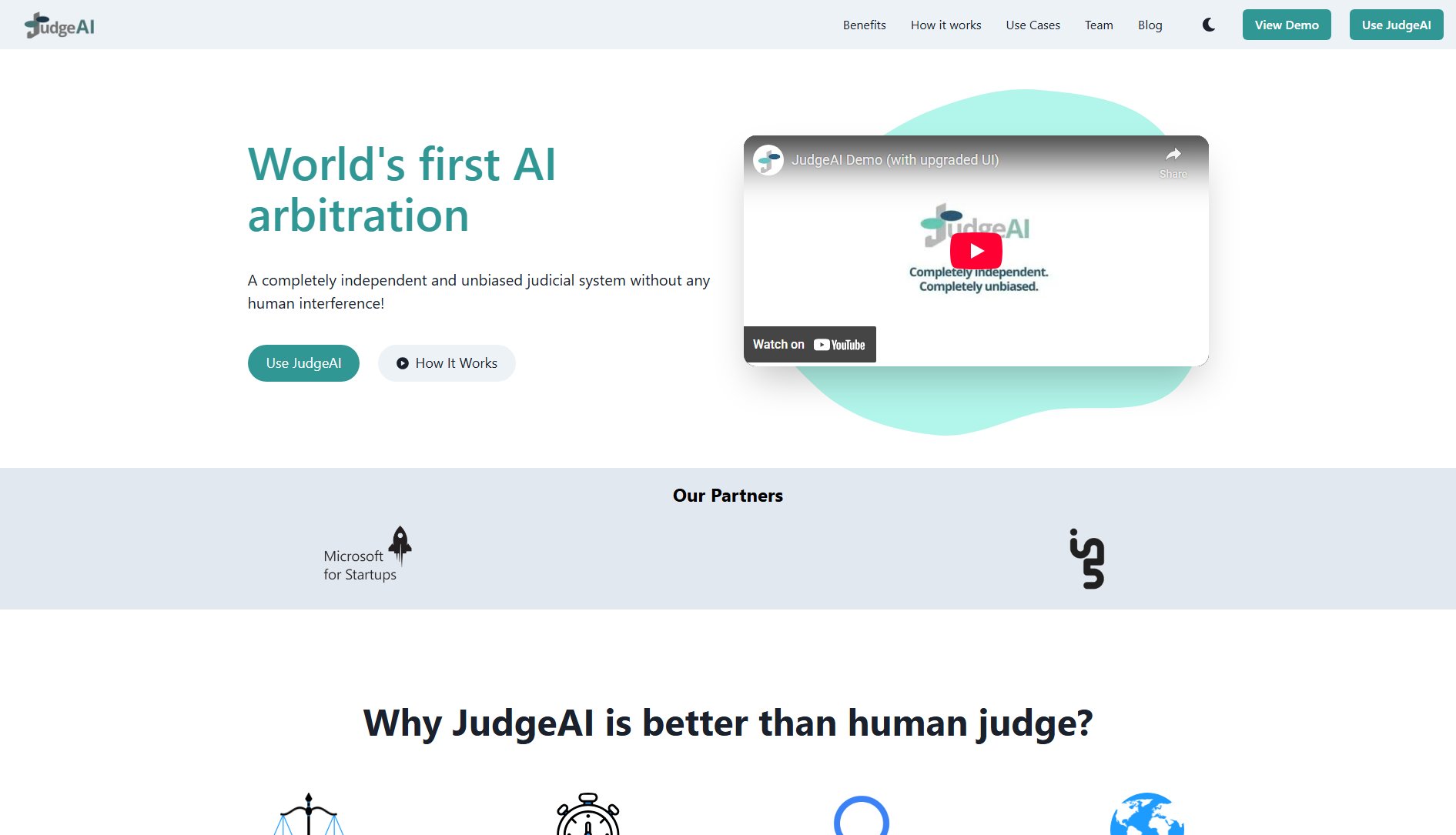
JudgeAI Official screenshot of the tool interface
What Can JudgeAI Do? Key Features
Robust Legal Algorithms
JudgeAI employs unique legal algorithms that operate independently of pre-trained data. These algorithms evaluate evidence and make judicial decisions with high accuracy, ensuring valid legal conclusions. The system does not rely on codified law or judicial precedents, making it independent of state influence.
Quick and Accurate Judgments
The AI-driven system processes claims and evidence swiftly, delivering accurate judgments without the delays typical of human courts. Its ability to analyze and synthesize large volumes of data ensures timely resolutions for legal disputes.
Evidence Analysis Using Multimodal AI
JudgeAI uses advanced multimodal AI to analyze diverse types of evidence, including text, images, and other data formats. This comprehensive analysis ensures that all submitted materials are thoroughly evaluated, leaving no stone unturned in the pursuit of justice.
Multi-jurisdictional Adaptability
The platform is designed to handle disputes across multiple jurisdictions, making it a versatile solution for international legal conflicts. Its algorithms adapt to varying legal frameworks, providing consistent and fair outcomes regardless of geographic location.
Automated Judicial Processing
JudgeAI automates procedural and administrative tasks within the judicial process, promoting consistent and unbiased case management. This feature minimizes human error and ensures that every case is handled with the same level of precision and fairness.
Best JudgeAI Use Cases & Applications
Business Contract Disputes
JudgeAI resolves conflicts arising from breached contracts by analyzing terms, evidence, and party behavior. Its impartiality ensures fair settlements, saving businesses time and legal costs.
Insurance Claims
The system evaluates insurance claims by assessing submitted evidence and policy terms. Its automated process ensures quick and unbiased resolutions, reducing the burden on human adjusters.
International Trade Disputes
JudgeAI's multi-jurisdictional adaptability makes it ideal for resolving cross-border trade conflicts. It standardizes judgments across different legal systems, fostering global business trust.
How to Use JudgeAI: Step-by-Step Guide
Submit your claim and evidence through the JudgeAI platform. The system will conduct a preliminary check to ensure the claim is formally valid. If valid, it proceeds to the next stage; if not, the claim is rejected immediately.
JudgeAI requests objections from the defendant. If the objections are deemed invalid, the claim is granted without further review. Valid objections trigger a counter-argument analysis and potential requests for additional evidence.
If necessary, the system requests clarifications or additions to the claim from the claimant. This step ensures all details are accurate and complete before forming the final case narrative.
The defendant may be asked to provide additional materials to complete the case picture. This ensures all relevant information is considered in the decision-making process.
JudgeAI forms a complete case narrative using fuzzy logic to evaluate facts and evidence. It assesses the interrelation and significance of each piece of evidence to the case.
The system models the ideal behavior of the parties, considering contract terms, business customs, and legal principles. It applies Nash equilibrium to evaluate possible behavior strategies.
The final decision is formed by comparing the actual behavior of the parties with the ideal model. Deviations are analyzed, and a fully justified decision is documented, ensuring transparency and fairness.
JudgeAI Pros and Cons: Honest Review
Pros
Considerations
Is JudgeAI Worth It? FAQ & Reviews
Yes, JudgeAI operates independently without human intervention. Its algorithms analyze evidence, evaluate claims, and deliver judgments autonomously, ensuring unbiased outcomes.
JudgeAI specializes in economic disputes where fairness can be equated with Nash equilibrium. It does not handle criminal or non-economic cases.
JudgeAI's decisions are highly accurate due to its robust legal algorithms and comprehensive evidence analysis. The system is designed to minimize errors and ensure fair outcomes.
Yes, JudgeAI is adaptable to multiple jurisdictions, making it suitable for international disputes. Its algorithms consider varying legal frameworks to deliver consistent judgments.
JudgeAI ensures fairness by applying Nash equilibrium to evaluate party behavior and evidence. Its impartial algorithms eliminate human bias, providing equitable resolutions.